Words: Unknown
Tune: Traditional (The Camooweal Races)
I went to see the Melbourne Cup
The Derby and the rest.
But of all the races I have seen.
The Cup it was the best.
There were but sixteen starters,
The pace was very fast.
And what we know, young Hales came home,
The winner at the last.
Go it Tommy Hales, my boy.
And I will back on you.
Hold him in a little while
And he will pull you through.
For if you win this race today,
You're the champion of the land.
And so he did, he won it too
The Melbourne Cup so grand.
Another from The Big Book of Australian Folk Song.:
The Melbourne Cup was collected in 1957 from Mr Brisbane, 81, of Hawthorn, Vic. He told me that when he was a boy he often heard songs of this nature being sung in the streets of Melbourne by broadside sellers. He said that frequently they were printed before a big race and were regarded as forecasts.
If this one belonged to that class then it was a sound tip, for the winner of the 1880 Melbourne Cup was Grand Flaneur, rider T Hales.
1. Come listen now, good people here
To a story of renown
of the day a hundred years ago
when the circus came to town
Mr Wirth and all his gallant crew
They raised the big top high
And all the folk for miles around
Gathered under a canvas sky
Chorus:
And were you there in the clear night air
when William Sinclair he fought the bear
Were you there to see William Sinclair
When he wrestled the bear to the ground
2. There were dancing ponies and tumbling clowns
The best you ever did see
A lion tamer and a high wire act
A girl on the flying trapeze
There was a fat ring-master in a big top hat
And he slashed his whip through the air
With a roar and a growl, a cage went clang
It was samson the mighty bear
3. He was ten feet high, he was nine feet wide
A mountain of muscle and fur
A mighty beast just as black ar the coal
The ground shook with his roar
Then the man with the whip He called for quiet
not a sound from those who were there
I've a crisp ten pounds for any man here
Who's brave enough to wrestle a bear.
4. Bill and his family had come to see the show
his youngest newly born
The strongest man to ever walk the range
He'd carry his weight in corn
he sized up the beast, with a glance at his wife
he slowly raised his hand
"I'll have a go", he heard himself say
then up struck the band
5. Stripped to the waist, bill entered the ring
Circling and bouncing round
First left, then right, 'til he lunged right in
The crowd didn't make a sound
They twisted and they turned as they wrestled and they grappled
At the skin and the muscle and the hair
With a mighty roar, Bill threw Samson down
He raised his fist in the air
6. You've never heard a roar quite like it
The shouts split the midnight air
Bill was raised above all the heads of the crowd
to the cheers of everyone there
And to this day, when you see the name
of the famous Bill Sinclair
Raise your glass and drink to the health
Of the only man to ever beat the bear.
The true story of a Glaswegian emigrant to Australia, William Sinclair, who became famous in the Maleny District of South-East Queensland for defeating a bear in a wrestling match when a circus visited Landsborough in the early 20th Century.
My father was a cocky as his father was before him
And I married me a cocky nearly fifty years ago
And I've lived here on this station and I've seen the seasons changing
From the drought round to the flooding, from the lambing to the wool
CHORUS:
And there've been times when I've wondered
If it all was worth the doing
And there've been times when I've thought
This was the finest place there is
For though the life here's never easy
And the hours are long and heavy
I'm quite contented nowadays
To have joined my life to his
Together through the thirties while others' lives were broken
We worked from dawn to twilight to hold on to what was ours
And at night we'd sit exhausted and I'd stroke his dusty forehead
With him too tired to talk to me and me too tired to care
Then the children came unbidden bringing laughter to the homestead
And I thanked the Lord my sons were young, too young for battle then
And I counted myself lucky to lose no one close to family
Though the neighbours lost their only son, sold up and moved to town
And the children have grown and left me for careers in town and city
And I'm proud of them but sadly for none chose station life
And now I smile to hear them talking of the hard slog in the office
For when I think of working hard I see a cocky and his wife
Another from the wonderful Judy Small.
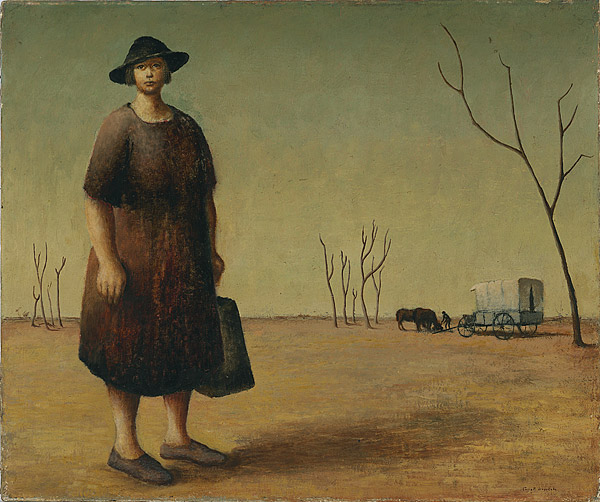
The illustration to this site is The Drover's Wife by Russel Drysdale.
I sailed to the west with a schoolmate of mine
And together we shared the hard toil.
It was hard times at home that caused us to roam,
No work for the sons of the soil.
So I bade me old father and mother goodbye,
And I said I'll not be long away;
For ten years have passed, fortune's favoured at last
And I'm leaving Australia today.
I sailed to the west with a dear pal of mine,
Each having a share in one claim
And taking bad luck as it came with the rest,
And working on just the same
Til a cowardly blow struck my poor pal low,
Who struck him I never could tell;
But the share of his gold placed close to my heart
For mother and dear sister, Nell.
Well I'm going back to my dear old home
That's far away over the sea
Right back to the scenes of my childhood
Where there'll be a welcome for me
Well many's the year it has passed away
Since I left old England's shore,
And may God speed the vessel that carries me back
To my dear old home once more.
I sailed to the west with a schoolmate of mine
And together we shared the hard toil.
It was hard times at home that caused us to roam,
No work for the sons of the soil.
So I bade me old father and mother goodbye,
And I said I'll not be long away;
For ten years have passed, fortune's favoured at last
And I'm leaving Australia today.
On Kate Burke & Ruth Hazelton's album "Swapping Seasons" the notes for THE MINES OF AUSTRALIA say "Trad. arr K.Burke, L. Plumb & R. Hazleton. Collected by Warren Fahey from Cyril Duncan, 1973, Queensland."
Warren's own site has two verses of this song collected from "Mrs D Clarke"
The illustration to this post is a photograph from the 1870s of "Simmons' (miners' office, mining agent, law agent and public accountant) and family outside his bark hut, Gulgong area, 1871-1875", American & Australasian Photographic Company. From the State Library of New South Wales collection.
At River Bend, in New South Wales,
All alone among the whales,
Busting up some post and rails,
Sweet Belle Mahone.
In the blazing sun we stand,
Cabbage-tree hat, black velvet band,
Moleskins stiff with sweat and sand,
Sweet Belle Mahone.
Chorus: Sweet Belle Mahone, &c.
In the burning sand we pine,
No one asks us to have a wine,
’Tis a jolly crooked line,
Sweet Belle Mahone.
When I am sitting on a log,
Looking like a great big frog,
Waiting for a Murray cod,
Sweet Belle Mahone.
Land of snakes and cockatoos,
Native bears and big emus,
Ugly blacks and kangaroos,
Sweet Belle Mahone.
Paddymelons by the score,
Wild bulls, you should hear them roar,
They all belong to Johnny Dore,
Sweet Belle Mahone.
A parody of a popular sentimental song from 1867, Belle Mahone.
“River Bend.”—This song certainly cannot boast of antiquity, as it is a parody on a recent sentimental song, but so many correspondents sent it in that it was decided to include it. Perhaps it is to its obvious sincerity of sentiment that it owes its popularity.
(I especially like the whales that are apparently found at the river bend!)
The harmonies for this post are those from the original published arrangement.
Words: Jack Wright Tune: Mike O-Rourke (a variation of The Little Old Log Cabin In The Lane)
You are just a lonely battler and you're waiting for a rattler You wish to heaven you were never born For you ran to dodge a copper and you came an awful cropper The skin on both your hands is cut and torn
You are tired and you're weary, lack of sleep makes your eyes bleary The soles of both your shoes are worn right through Your heart is sore and aching and your back is nearly breaking Your coat and shirt and pants have had it too
Chorus: And it's hey, hey hobo, you're just a rolling stone Though you're stony broke, if you still can crack a joke You're as good as any king upon his throne
Your blood is nearly boiling and your muscles need no oiling As you duck and dodge the headlight's brilliant glare For you've seen the copper's wood heap and you know that it's a good heap You know the tucker's not the best in there
Then the engine gives a whistle, you trip up on a thistle Get tangled up in signal wires and points Then you blunder in the gutter and angrily you mutter 'Well, strike me pink, of all the flamin' joints!'
First Repeat chorus And it's hey, hey hobo, you're just a rolling stone Though your pants are wearing thin, if you can still raise a grin You're as good as any king upon his throne
Then you see the green light flashing and hear the bumpers crashing You see the great big engine rushing by With your swag all at the ready, your nerves are not so steady For you know you'll have to take her on the fly
Then your swag you try to throw in , but the flamin' thing won't go in Bounces off the truck and hits you, and you fall Pick the remnants of your swag up, pick your billy-can and bag up You say, 'I missed the bastard after all!'
Second Repeat chorus And it's hey, hey hobo, you're just a rolling stone Though the sky is looking grey, there will surely come a day When you'll own a bloody railway of your own.
Written by Jack in the 1930s. Appearing here via Mudcat and with the much-appreciated help of Tony Suttor.
Bob Bolton has advised by email that Jack Wright also wrote a tune for this one. I'm trying to track it down.
Sure I am a wild young Irish boy and from Dublin town I came
Transported out to Van Dieman's Land; of it I ain't ashamed
Sure I'll have you all to know, me boys, that wherever I may be
I'll die at my post like an Irish lad, or a wild colonial boy
Now, I done my time in Hobart and they sent me over here.
They yoked me to a plough the fields for me to tier.
But I didn't understand farming as I had been to sea;
I'd sailed the oceans far and wide, so I a farmer could not be.
But I became a bold young renegade and I traveled far and near.
Oh, I robbed the rich and I gave to the poor; of it I ain't ashamed,
But I never killed a man that didn't cause me any pain;
But the troopers knew Jack O'Brien, and they let me ride for gain
Now, one morning in the merry month of May, sure I did find
A wagon bringin' in gold from the Bendigo find.
"Oh, halt, you boys, and 'old up your 'ands!"-when a sergeant did appear
Says he, "Look, Jack O'Brien, me boy, you'll do this once too near!
"Your time it is over and you sure must fight or die!"
"Then I'll fight the six of you troopers, and I am only one.
Sure I'll fight to the end or victory, and I don't give a damn.
I'll be at my post like an Irish lad or a wild colonial boy,"
Now, the six troopers fell upon the ground, from their 'orses off did slide
And the sergeant he cried out to Jack Donahoo [O'Brien?] to abide
"By, the law, you're a prisoner!" "Then take me," said old Jack.
"But Sergeant, you've got some children, and look that I don't
shoot the track!
"McKenzie, you're a brave man, and I 'ate like 'ell to do,
To take your wife and children's bread from them for to kill you
So take my advice and ride away, and don't say what I've done.
I'm only takin' this gold to buy some pleasin' place for some."
Now when I'm far away and the farmers all will buy
Fine horses and fine wagons for their farms to die upon,
Sure you'll all live to wonder why Jack Donahoo [O'Brien?] would say
That I work for the farmers night and day, and for the rich and
poor I've prayed.
I've robbed the coaches day and night, but I never robbed the poor.
I have never committed murder, nor have I strayed from fields galore.
I'm chased from country to country and from borderline to town
But ne'er can they catch bold Jack again, for O'Brien is far away.
Now at last I'm lying on my bed and God does only know
I haven't long to live, I know, for I surely must go.
I would love to tell the truth-oh, before I pass away,
But I would love for some poor person to collect that bounty pay!
Sure I'm still a wild old renegade; Starlight is my name.
Oh they've looked for me from shore to shore and along the coast for miles
From state to state they've chased me, and at last I'm on my bed
If that newsboy would only come in, I'd tell him what to do
Just then the door it opened and the newsboy did come in
"Good mornin', Captain Starlight. Oh, good morning, sir," he said.
No answer but a beckon and a little note to say:
"Jack O'Brien is dying and he wants you for to take
"This note unto your mother, and let her do the rest,
And call the doctor first, and the police can come at last.
They can take my body away, and they never will be able to say
That Jack O'Brien didn't die like an Irish lad or a wild colonial boy!"
Now, I've traveled through the bushes, oh, both night and day,
With my bundle on my shoulder and a billy-can in my hand;
But I've always played the game, as every Australian should,
I've died at my post like an Irish lad, or a wild colonial boy.
An interesting variation on the Wild Colonial Boy theme, although any attempts at a rhyming pattern seem to have been abandoned by the end! There is also the slightly confusing issue of the protagonist's identity.